Monday, March 30, 2026
9:15 a.m. - 10:30 a.m. (GMT+03:00) Doha
The rise of China is the most astonishing historical event of the last half-century. What made it possible, and what does it portend for the rest of the world: Asia, Africa, and Latin America, as well as Europe and the United States? Is it possible to step out of Western narratives that depict China as a threat? Can we imagine—and work towards—a world in which China and other countries together address existential threats posed by climate crisis, AI, and war?
Participants
Kaiser Kuo
Kaiser Kuo is a musician, writer, and the host and co-founder of the Sinica podcast, the leading English-language podcast on current affairs in China. Since April 2010, Sinica has published over 500 episodes featuring prominent diplomats, academics, journalists, and others with expertise on China. Previously, Kuo served as director of international communications for China’s leading search engine, Baidu. Kuo graduated from the University of California, Berkeley in 1988 with a degree in political science and received a master’s degree in East Asian studies from the University of Arizona. He was lead guitarist and co-founder of Tang Dynasty, a Chinese heavy metal band founded in 1989.
José Casanova
José Casanova is a senior fellow at the Berkley Center for Religion, Peace, and World Affairs. He is also professor emeritus at Georgetown University, where he previously taught in the Department of Sociology and the Department of Theology and Religious Studies.
Lijia Zhang
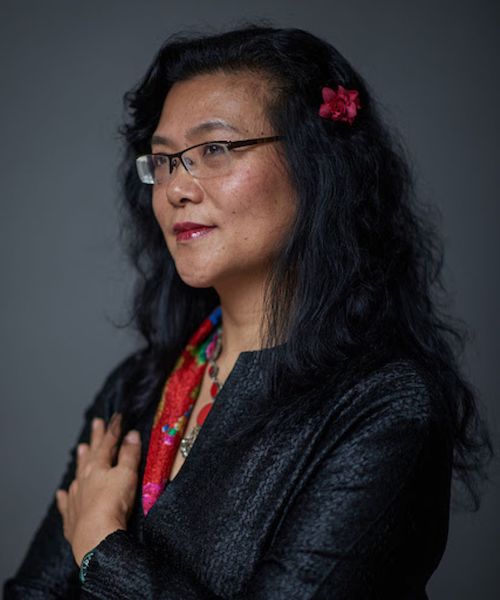
Lijia Zhang is a rocket-factory-worker-turned-writer and social commentator. At 16, she was put to work in Nanjing where she taught herself English. Now she is one of the few Chinese authors who writes regularly in English for international publications, such as the New York Times. She is the author of the critically acclaimed memoir Socialism Is Great! (2011), and her debut novel Lotus (2017), on prostitution in China, came out in 2017. She is a recipient of the prestigious fellowship for writers at the University of Iowa. She is a regular speaker on the BBC, Channel 4, CNN, and NPR.
Anne-Sophie Pratte
Anne-Sophie Pratte is assistant professor of history at Georgetown University in Qatar. She specializes in the early modern history of China and inner Asia, with a focus on historical cartography, China-Mongolia relations, and environmental history. Pratte explores the role of Mongol maps in the making of Qing imperial geography in her forthcoming book project, Where the State Meets the Steppe: The Politics of Cartography in Qing Mongolia, 1780-1911. She has published her research in the journal Late Imperial China and in Études Mongoles et Sibériennes. Pratte received her Ph.D. in inner Asian and Altaic studies from Harvard University.
Accessibility
Please email globaldialogues@georgetown.edu by March 25 with any accessibility requests. A good-faith effort will be made to fulfill all requests made after this date.